

Report from site visit in December 2025
Arriving in Wroclaw in the evening was the best moment to plunge into the Christmas Market that was spanning across all of the city center. Locals but also visitors from neighboring countries took the opportunity to gather while sipping on a variety of Grzaniec – mulled wine drink. It was very easy to feel warm and welcome from the first moment.
It was not too surprising to hear in our meeting with the city representatives the next morning that Wroclaw is the most preferred place to move within Poland, especially for foreigners. The team at the Municipality unfolded to us the story of the City of Equality (miasto rownosci) that embraces more than 100 nationalities. As the Vice President of Wroclaw, Jakub Mazur, highlighted “ We need to think in holistic terms, we are changing from a green to human centric approach.” Wroclaw’s 30 public and private universities welcome 10 000 foreign students in a diversity of fields from art to engineering. The Strategy Wroclaw 2050 positions the city as the meeting place ready for the future.
From the City Hall we headed directly to visit venues in the Wuwa district – cultural heritage area of Wroclaw that also received the European Heritage Label. Our first steps led into the Wroclaw’s Congress Center, known for its majestic Centennial Hall which was built in only 13,5 months. Its use varies from basketball matches to film sets (including the Game of Thrones). The Congress Center overlooks a beautiful park with a fountain, creating a wonderful platform for the main festival venue.

Only ten minutes walk away (including an opportunity to indulge in one of Wroclaw’s specialty coffee places) we continued our exploration to the old tram depot, Czasoprzestrzeń (space-time), awaited pronunciation challenge of Placemaking Week Europe 2025. We entered through a cosy courtyard handily equipped with colourful pallet furniture, curious objects, decorations, lights and with a community garden at the back. Inside, Adela Jakielaszek (Social and Educational Manager) introduced us to the immense variety of activities, organisations and individual actions that keep transforming this empty ex-depot into a cultural and community center. The Center for Young Culture and Local Initiatives Czasoprzestrzeń is a place truly resistant to crisis. Since 2017 it is hosting festivals and cultural events, workshops, scientific, ecological and entrepreneurial events but also acting as a “free supermarket” supplying goods to people from Ukraine organised by Tratwa.

Another short walk away, deeper into the Szczytnicki Park we found ourselves in a small church that had been during the European Capital of Culture project in 2016 transformed to Open Cultural Center. This 16th-century wooden structure was relocated, originally from Stare Koźle, moved to Wrocław for the 1913 Centenary Exhibition. Currently it hosts a diversity of community events on a seasonal basis.

Wroclaw’s public spaces threaded by the river Odra and over 100 bridges create opportunities for refuge into nature. The District of Four Faiths hosts four religious buildings—Catholic, Orthodox, Protestant, and Jewish. Its eclectic dimension augments the Ruska 46, night time venue, cultural space and Neon Gallery. The gallery of neon signs is since 2014 a cooperation between the city and the Neon Side Wrocław foundation.

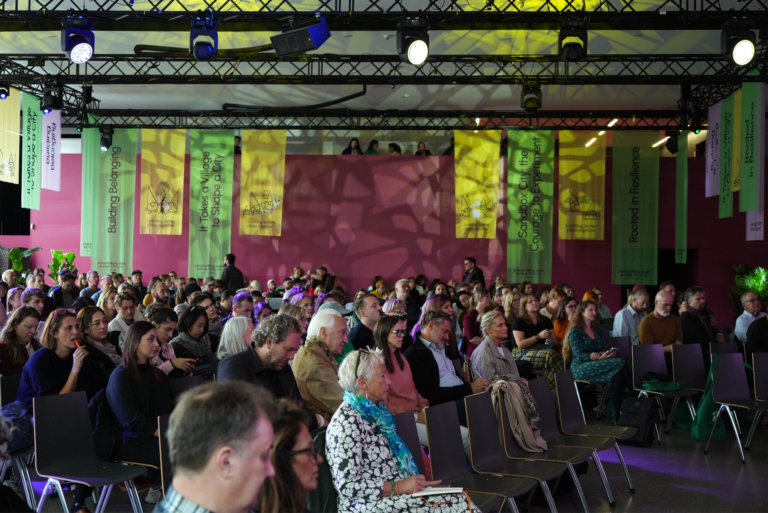
In 2026 the city will celebrate the 10 years anniversary of its European Capital of Culture project which defined local culture as a dream of shared values. Its main institutional legacy Wroclaw Cultural Institute has its home in the cultural activity space and café, Barbara. On the second day of our site visit we had the opportunity to gather here with 36 representatives of local organisations, initiatives, academic institutions and city experts. The participants highlighted the strength of local partnerships and strongly identified with the multicultural dimension of the city saying that Wroclaw is a city of everyone – “it is in the city’s genes” one group said. Strength of civic action comes also from 24 local activity centers spread around the city. Microgrants enable realisation of small projects on an open call basis, and the community also appreciates the institutions and Wroclaw Strategy 2050.
Our last stop included the Leśnica district (and Leśnica Castle – cultural center) on the first day of transforming a car park into a christmas market. Coming back to the city via the old tram depot Popowice that is also in an ongoing transformation, currently housing vintage trams and buses refurbished by a passionate volunteer organisation Klub Sympatyków Transportu Miejskiego.

After the three days, we left Wroclaw with more ideas than one Placemaking Week Europe can probably handle and with new connections and friendships that we are excited to bring to the festival in September 2026.


