Every time I return to Mexico City, I leave with the same renewed question: the city for whom? It is an old debate, but in CDMX it feels urgent and concrete. A city cannot solve all the world’s problems. But it can show the world that people matter. Former mayor Marcelo Ebrard once framed it in a conversation with Francisco Goldman: the city does not fix everything, but it can make each person feel that they count.
That sentence explains a great deal. It explains the early bet on cycling when it seemed like an elitist fantasy. It explains the Metrobús system at a time when the private car was still a symbol of social mobility. It explains why intervening in mobility, even when controversial, has been politically more feasible than intervening in housing.
Because housing remains the unfinished agenda. And this is not unique to Mexico. Across many cities, we see distributed speculation: small property owners turned financial actors, fragmented markets reproducing inequality without a single obvious villain. Transforming mobility is one thing. Transforming housing means touching intimate interests. It means real disruption.
Mexico City has demonstrated that it can transform mobility. It has not yet demonstrated that it can structurally transform access to housing. And yet, even with that open wound, it remains a city of refuge.
That is not a minor achievement. CDMX has been relatively safe even when the country has been marked by extreme violence. There is no single explanation, but there are clues: universities like UNAM as engines of critical thought; a long tradition of welcoming exiles from Spain, South America and Central America; a dense and vibrant public realm where conflict does not automatically spill into street warfare. And perhaps most importantly, a political intuition that violence reproduced in public space only multiplies itself.
North of the border, a different logic often prevails: singular, technological, surgical, destructive solutions. The algorithm will fix it. The wall will fix it. Policing will fix it. Urban surgery will fix it. None of these approaches resolve intractable problems. They merely displace them.
Intractable problems cannot be optimised away. They do not admit a final solution. They are not corrected by an app. They are structural inequality, urban loneliness, housing exclusion, cultural fragmentation and fear.
A few weeks ago, at Placemaking Week Mexico, I spoke about the tension between metrics and place. The most important things are difficult to measure: trust, care, shared time, belonging. And yet what we choose to measure reshapes the place itself. If we measure footfall, we program to fill. If we measure consumption, we prioritise those who pay. If we measure profitability, we displace other uses.

Mexico City stands precisely on that edge. It is culturally explosive, gastronomically unstoppable, socially vibrant. But it is also a city where neighbourhoods like Roma and Condesa are filling with “exiled” remote workers fleeing the cost of their own cities rather than political persecution. A city of refuge, yes. But also a city under pressure from global capital.
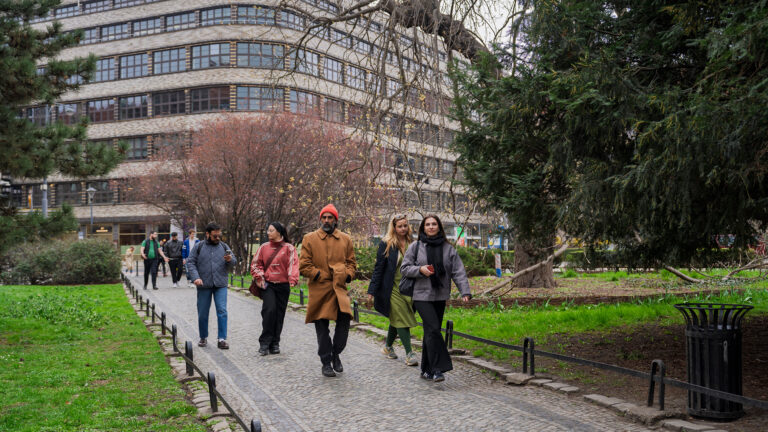
And still, something holds. It holds in parks alive with intergenerational life. In light, temporary interventions that transform an alley without promising redemption. In placing children at the centre of public space design. In the constant mixing of cultures, classes and generations.
Perhaps that is why the question of “global leadership” is not the right one. Mexico does not need to lead in the traditional sense. Latin America does not need to replicate the North. It is already producing a different modernity: mestizo, hybrid, conflictive and fertile.
Mexico City does not offer a universal solution. But it demonstrates something essential: the city can be a space where conflict is neither denied nor erased, but collectively processed.
And no algorithm can do that for us.