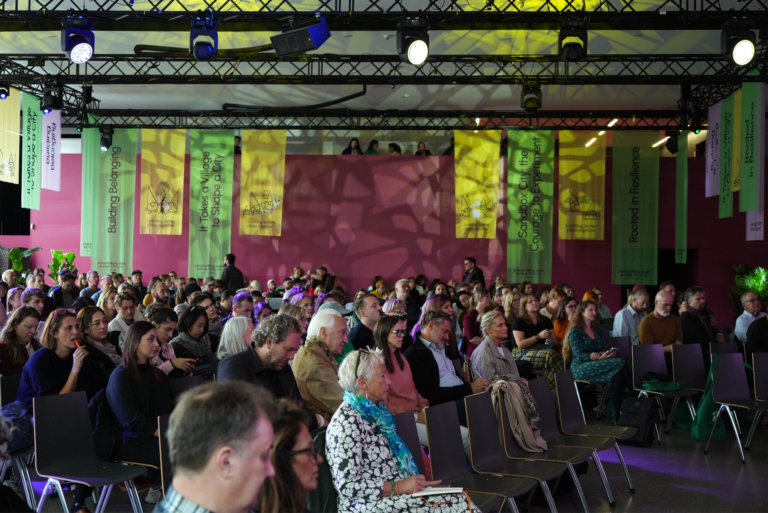

When facing rapid changes across Europe and beyond, cities are confronted with a shared question: how do we create places where people not only live, but genuinely feel they belong? The theme Building Belonging responds to this challenge by shifting the focus towards human relationships and a sense of ease and comfort in the places we inhabit, highlighting that the quality of urban life depends not only on what is built, but on the opportunities we have to connect within it.
Belonging, in this sense, goes far beyond access. It is about feeling at ease on the one hand, and on the other having a voice and being able to participate in shaping everyday urban life. It is also about trust, as well as genuine interest in and care for one another – between neighbours, across cultures, and between residents and institutions. In a time marked by mobility, uncertainty, and social fragmentation, fostering this sense of connection has become one of the most important tasks for contemporary cities.
The city of Wrocław offers a particularly meaningful context to explore this theme.
A city where belonging is constantly being built
Wrocław’s history is not one of gradual continuity, but of rupture and reinvention. After World War II, the city underwent a profound transformation and its identity was constructed anew by people arriving from different regions, backgrounds, and experiences. From the outset, Wrocław approached this process with openness, captured in the phrase that it was “a city with no people, welcoming people who had no city”.
This legacy continues to shape how belonging is understood today. In Wrocław, it has never been something inherited or taken for granted. Instead, it has been created – through shared effort, negotiation, and everyday coexistence. The idea that a city can be collectively shaped by those who choose to live in it remains deeply embedded in its character, especially in a time of rapid growth, talent attraction, and economic development happening now in the city of Wrocław.
Public space as a social infrastructure
One of the key insights behind Building Belonging is that public space is rarely neutral – it can either enable or limit connection. In Wrocław, there is a growing recognition that streets, squares, and even overlooked in-between spaces can serve as platforms for interaction, exchange, and mutual support.


A strong example of this is the Passage of Dialogue, an initiative that reimagines a central pedestrian underpass as a place for meeting, learning, and intercultural exchange. It also served as one of the main reception points in 2022, when over the course of just a few weeks more than 150,000 Ukrainian refugees were welcomed to the city. What might otherwise remain a purely functional transit space becomes a point of entry into the social life of the city – especially for those who are new to it.


Equally important are the Local Community Centres (Centra Aktywności Lokalnej), which operate at the neighbourhood scale. These spaces provide room for everyday activities – workshops, meetings, cultural activities and shared meals – that bring together residents who might not otherwise cross paths. They demonstrate that belonging is often built not through large gestures, but through repeated, small encounters. And even if not all the neighbors take part in the organised activities, they are still more than welcome to use it informally – for example by borrowing chairs or tables for their family meetings – and that also speaks for the sense of belonging, openness and community.
Dialogue, care, and the work of connection


Belonging also requires the ability to navigate differences. This is where organisations such as the Dom Pokoju Foundation play a crucial role. Their work focuses on dialogue, mediation, and building relationships across social and cultural divides. Rather than avoiding conflict, they treat it as a starting point for understanding and transformation. Through educational programmes, neighbourhood initiatives, and mediation practices, they create conditions where people can communicate openly and constructively. This approach reflects a broader shift in how cities think about cohesion – not as uniformity, but as the capacity to live together with differences.


Another important dimension of belonging in Wrocław is participation in shared experiences that connect personal lives with the city itself. The programme “WROśnij we WROcław” is a strong example of this approach. By inviting families to plant trees for newly born children, the initiative creates a lasting bond between residents and the place. It turns a personal milestone into a collective act, and a piece of urban greenery into a living marker of belonging. Over time, these trees become part of both the city’s landscape and its memory – growing alongside the people they represent. Such initiatives show that belonging can be nurtured through simple yet meaningful actions that combine care for the environment with care for community.
From local experience to global relevance
While rooted in a specific context, the lessons from Wrocław resonate far beyond it. Many cities today are grappling with similar challenges: how to integrate diverse populations, how to reduce loneliness, and how to ensure that public spaces remain accessible and meaningful to all.
Building Belonging invites us to think of urban development as a social process that emerges through relationships, participation, and the everyday experience of being part of something shared. It asks how cities can support interaction, encourage connections, and create conditions where people feel seen and included – regardless of how long they have lived in a place or where they come from. As cities continue to evolve, this understanding becomes essential. Ultimately, a successful city is not only one that functions efficiently, but one in which people feel that they truly have a place.